Validation case
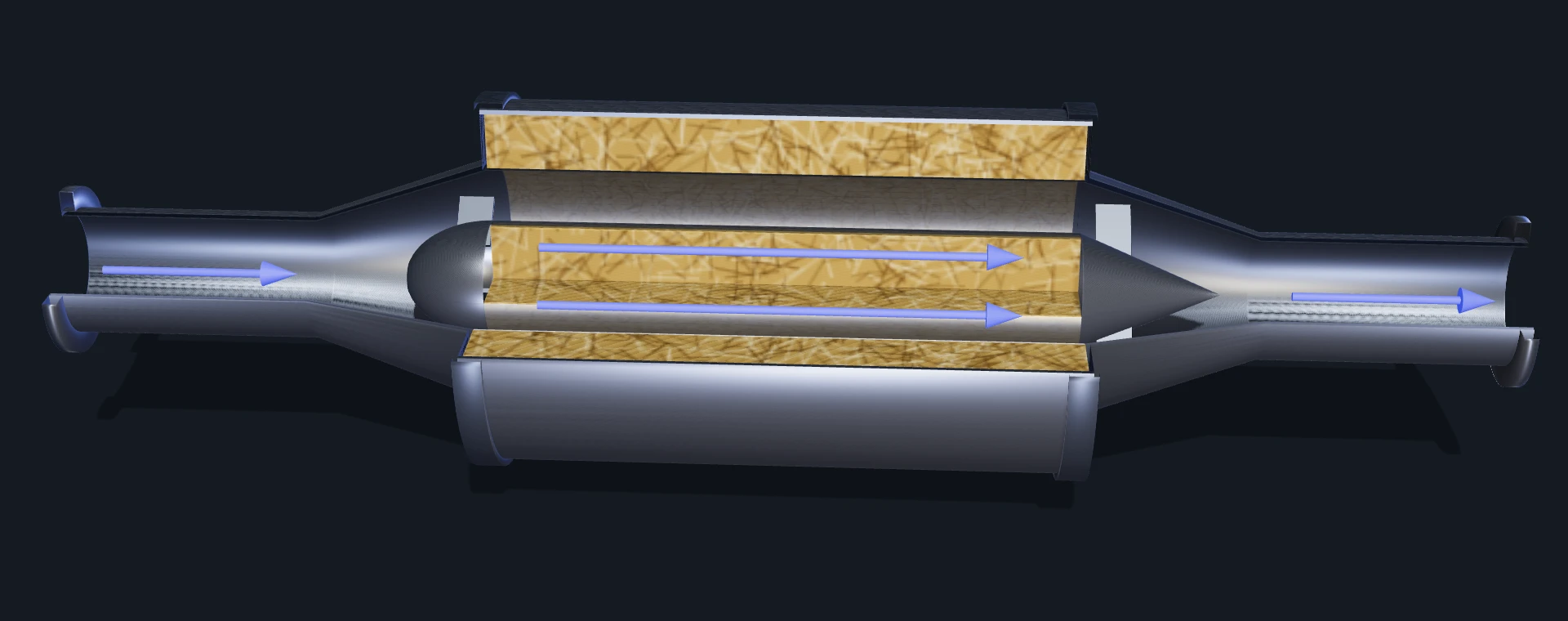
Pod silencer with absorbing pod and lining
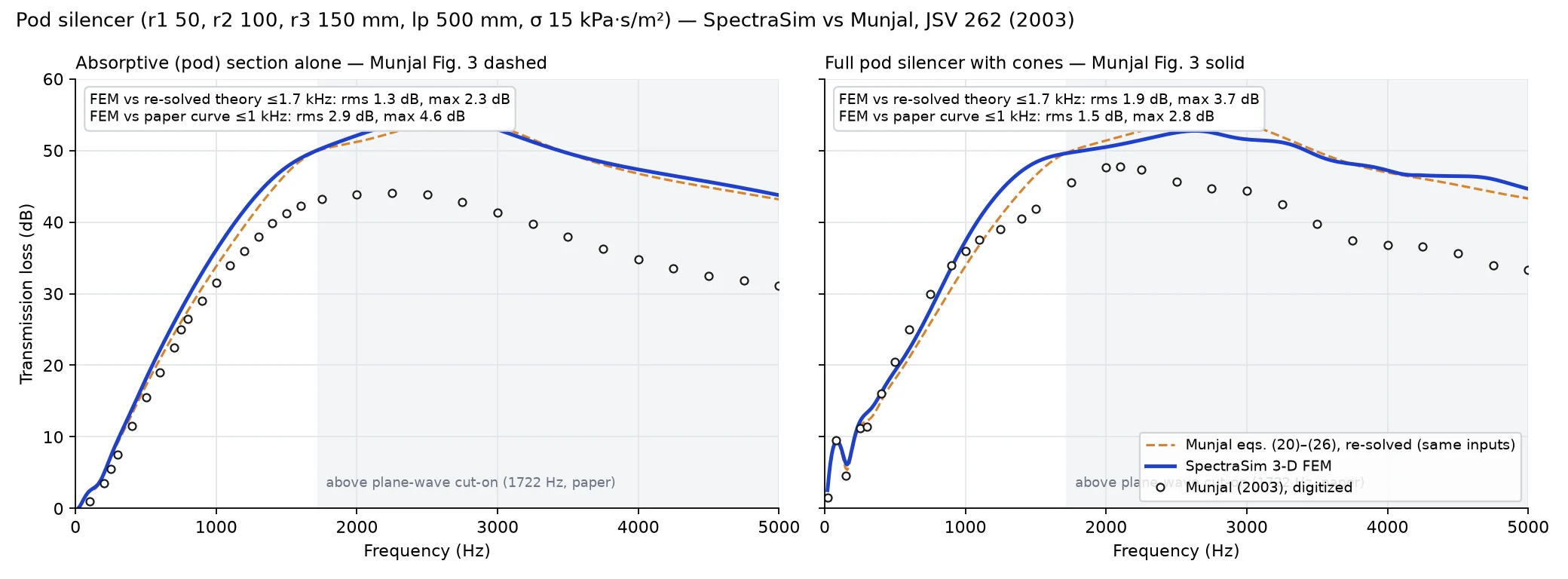
Against the paper’s own plane-wave theory (Munjal, 2003), solved again with the same inputs, for the pod silencer with absorbing pod and lining (Munjal, 2003), 20–5000 Hz, SpectraSim gives: absorbing section rms 1.3 dB, largest 2.3 dB below the 1.7 kHz cut-on; the paper's printed curve is matched below 1 kHz (rms 2.9 dB) and lies 7–13 dB lower above it, most likely an unreported protective perforate.
1.3 dB TL rms difference below the 1.7 kHz cut-on
Results
How close is SpectraSim?
Absorbing section rms 1.3 dB, largest 2.3 dB below the 1.7 kHz cut-on; the paper's printed curve is matched below 1 kHz (rms 2.9 dB) and lies 7–13 dB lower above it, most likely an unreported protective perforate.
Model and set-up
- Reference
- The paper's bulk-reacting plane-wave theory, solved again with the same inputs
- Pod radius 50 mm, flow passage to 100 mm, lining to 150 mm, 500 mm long; cones of 150 mm to pipes of 50 mm radius.
- Pod and lining: 15 kPa·s/m² packing with Mechel’s Delany–Bazley constants, entered as user constants; no protective perforate (the paper gives none).
- Air at 24.6 °C; a 30° sector with symmetry planes, exact for plane-wave excitation; 229 frequencies from 20 Hz to 5 kHz.
How to read the result
- The reference is the paper’s own bulk-reacting plane-wave theory, solved again with the same inputs, so both sides use exactly the same data.
- Full silencer at low frequency: the 80 Hz peak (9.3 against 9.5 dB), the 150 Hz dip and the 250 Hz shoulder are reproduced.
- Above about 1.2 kHz the paper’s printed curve lies 7–13 dB below both SpectraSim and the re-solved theory: the gap is in the paper’s inputs, most likely an unreported protective perforate. Its figure is a check below 1 kHz only.
Selected cases
Other validation cases
-
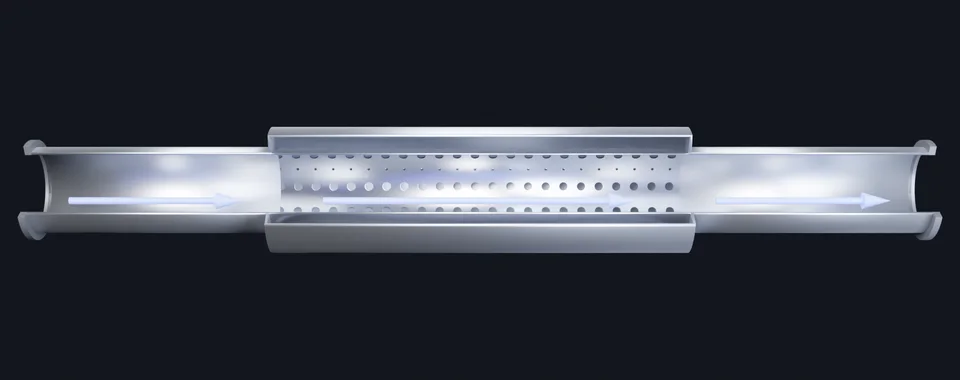 Measured Concentric-tube resonators ≈ 2 dB peak levels against measured
-
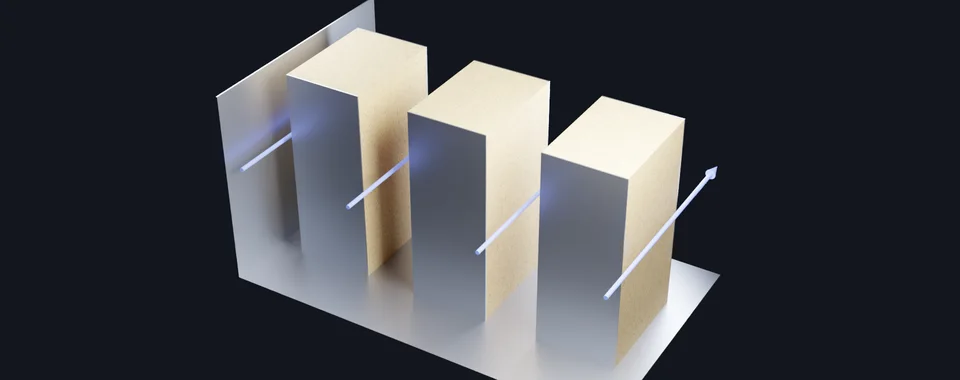 Measured Parallel-baffle (splitter) silencer 1.37 dB TL rms difference, 50 Hz to 4 kHz
-
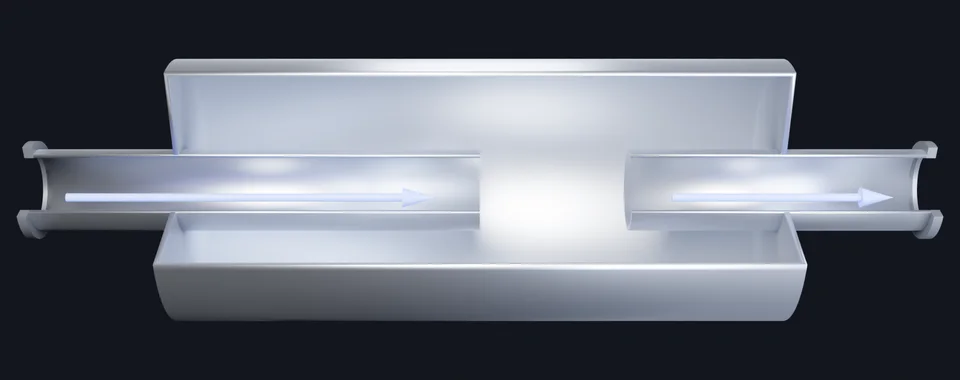 Code-to-code Muffler with an extended-tube chamber 0.12 dB TL rms difference, 20 Hz to 1 kHz
-
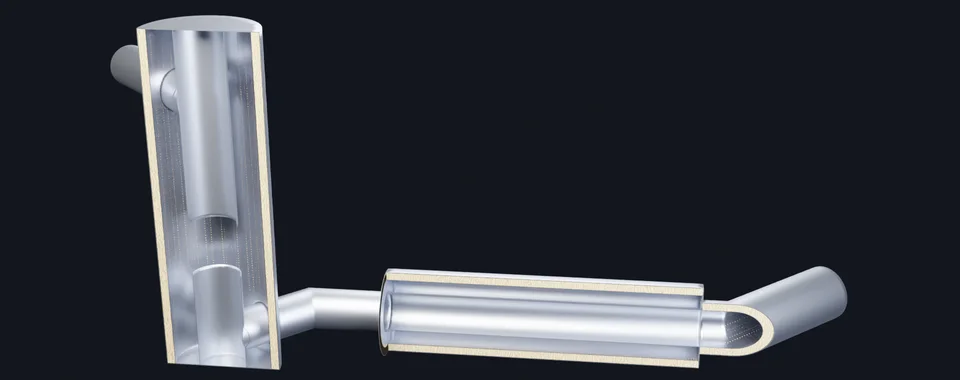 Code-to-code Exhaust muffler with three absorbing packings 0.16 dB TL rms difference, 20 to 500 Hz
-
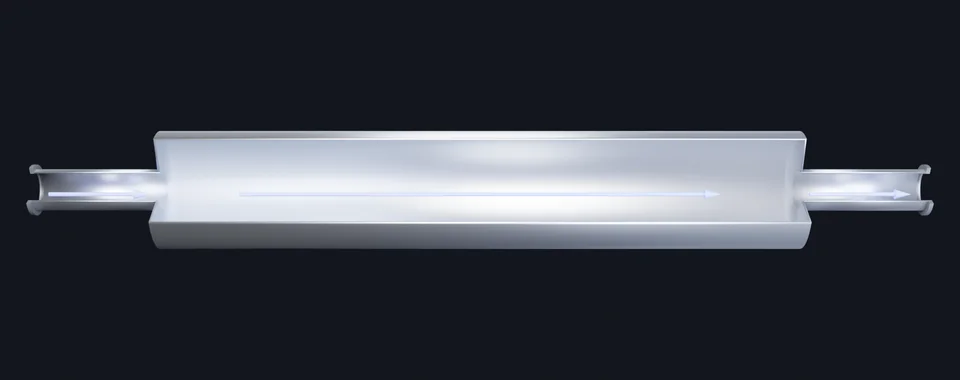 Analytical Expansion chamber against the exact 1-D solution 0.36 dB below 0.4 of the first cross-mode cut-on
Check it on your own muffler.
Download SpectraSim and run your geometry, or let our engineers run the study and compare it with your test.