Duct acoustics, applied where the noise is.
Every application below is a duct carrying sound and flow. Exhaust mufflers and silencers are where SpectraSim is strongest today.
SpectraSim is built for exhaust mufflers on automotive, off-highway and mining engines; genset and large reciprocating-engine silencers; small-engine mufflers; and HVAC duct silencers such as parallel-baffle (splitter) and pod silencers. All share one task: reach an attenuation target within a pressure-drop limit, with perforates and absorbing linings in the way.
How do you simulate an engine exhaust muffler?
Automotive, off-highway and mining equipmentHit the engine maker's back-pressure limit and the TL / IL target at once — with hot gas, perforated tubes and packing in the way.
Back-pressure and total-pressure loss by CFD; transmission loss, insertion loss and radiated SPL by finite elements, in the temperature field the flow solution delivers. Insertion loss and radiated SPL are computed without mean-flow convection.
- TL / IL
- Radiated SPL (A)
- Back-pressure
- Δp₀
- Temperature field
How do you simulate a genset silencer?
Reactive and absorptive silencersMulti-chamber silencers with multiple inlets and large diameters, where cross-modes appear early and 1-D network models stop working.
Full 3-D acoustics: every port carries all the duct modes that propagate up to the highest frequency, so cross-modes are handled at the ports. Transmission loss per inlet, absorbing packing and internal walls; the CFD gives the pressure drop per inlet and the flow split per outlet.
Code-to-code SpectraSim has been compared with a commercial finite-element code on a two-inlet muffler with eight internal walls, 450 °C, 20–500 Hz: median 0.9 dB, rms 3.2 dB; the sharp notches (65 dB) carry the largest differences; the reference mesh's convergence is not known. Two-inlet muffler in the validation table
- TL per inlet
- 1/3 octave TL
- Port powers
- Flow split
How do you simulate a small-engine muffler?
Lawn mowers, small generators and power toolsCompact, hot and with a tight back-pressure budget: there is little room to add attenuation without losing power.
Coupled flow, heat and acoustics on the compact geometry, so the temperature drop through the muffler and the back-pressure are counted in the transmission loss.
- TL
- Back-pressure
- Wall heat loss
- Outlet temperature
How do you simulate an HVAC duct silencer?
Parallel-baffle (splitter) and pod silencers for ventilation and air-handling ductsReach the attenuation the room needs at a pressure drop the fan can afford — with absorbing linings, facings and airways wide enough for cross-modes to cut on in the middle of the frequency range.
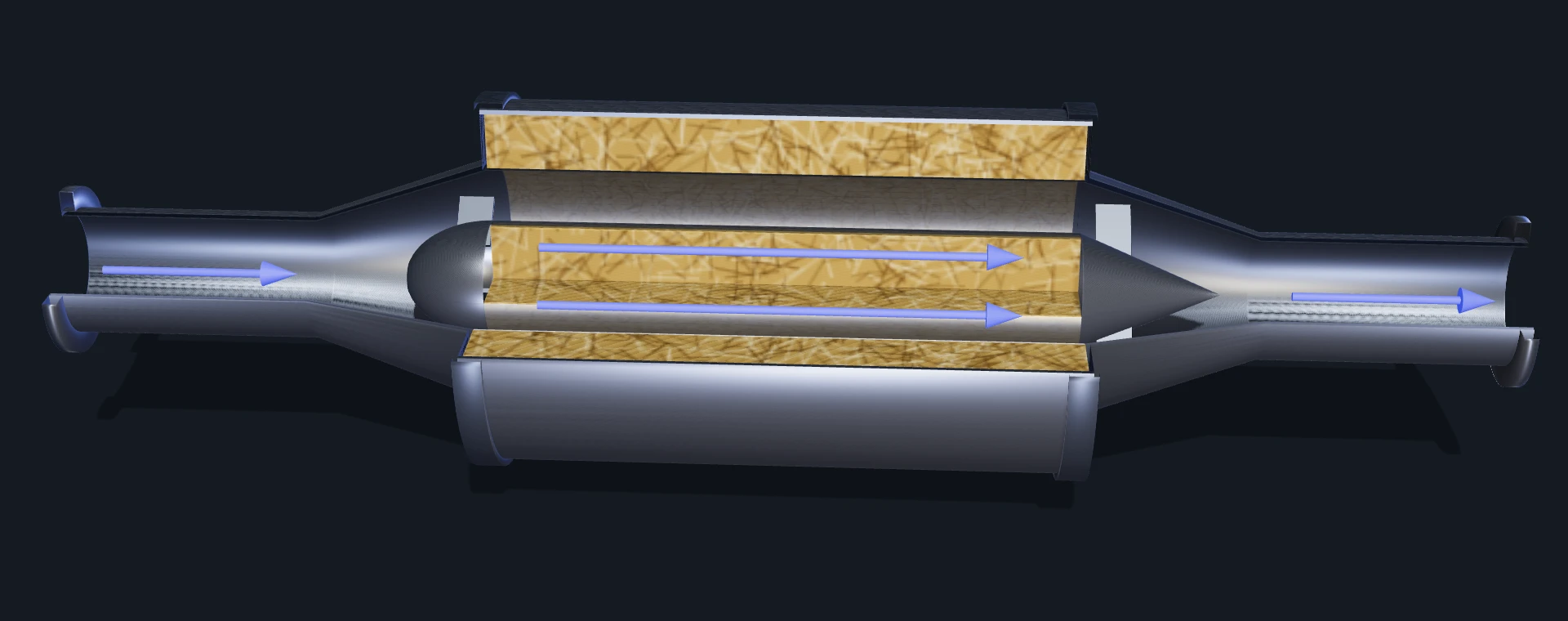
Finite-element transmission loss with the linings and pods as absorbing-material regions, facings as resistive perforates and splitter heads as rigid walls. A splitter silencer can be modelled as one periodic cell — half a splitter and half an airway between symmetry walls. The CFD gives the pressure drop.
Measured Against measured transmission loss (Mechel, Formulas of Acoustics, 2008, J.22), parallel-baffle (splitter) silencer, mineral fibre with a porous foil cover, 50–4000 Hz: rms 1.37 dB, largest 2.94 dB; all bands from 100 Hz to 4 kHz within ±3 dB; the 630 Hz peak reproduced. Parallel-baffle silencer in the validation table
Analytical Against the paper's bulk-reacting plane-wave theory, solved again with the same inputs, pod silencer with absorbing pod and lining (Munjal, 2003), 20–5000 Hz: absorbing section rms 1.3 dB, largest 2.3 dB below the 1.7 kHz cut-on; the paper's printed curve is matched below 1 kHz (rms 2.9 dB) and lies 7–13 dB lower above it, most likely an unreported protective perforate. Pod silencer in the validation table
- TL
- 1/3 octave TL
- Absorbing linings
- Pressure drop
Can SpectraSim be used for research and teaching?
Universities and test labsStudents and researchers need to see why a result is what it is — not just the number.
Every parameter has a Help article (F1) with its theory, equation, default and references. Sample projects — a straight pipe, a sudden expansion, an expansion chamber — open ready to run and are compared with textbook relations; measured curves can be imported and overlaid with error metrics.
- Theory per parameter
- Equations
- Sample projects
- Measured overlays
All visuals on this page use generic sample models or published reference cases. Client geometry and results are shown only with permission: [MISSING M36 — permission to show client geometry]
Applications, answered
- What is SpectraSim used for?
- Designing engine exhaust mufflers, genset and large-engine silencers, small-engine mufflers and HVAC duct silencers: SpectraSim predicts their transmission loss, insertion loss and radiated noise together with back-pressure and heat loss, from one 3-D CAD model.
- Can SpectraSim simulate a silencer with several inlets?
- Yes. Each inlet gets its own boundary conditions and its own transmission loss and pressure drop. SpectraSim has also been compared with a commercial finite-element code on a two-inlet muffler with eight internal walls, 450 °C, 20–500 Hz: median 0.9 dB, rms 3.2 dB; the sharp notches (65 dB) carry the largest differences; the reference mesh's convergence is not known.
- Can SpectraSim model HVAC duct silencers?
- Yes. Parallel-baffle (splitter) and pod silencers are modelled with absorbing linings, resistive facings and rigid splitter heads. Against measured transmission loss (Mechel, Formulas of Acoustics, 2008, J.22), a splitter silencer gives rms 1.37 dB, largest 2.94 dB; all bands from 100 Hz to 4 kHz within ±3 dB; the 630 Hz peak reproduced.
- Is SpectraSim suitable for teaching acoustics?
- Yes. Every parameter has a Help article with its theory, equation, default and references, and sample projects such as an expansion chamber are compared with textbook relations.
Have a muffler or silencer to design?
Every licence includes every feature. Or let our engineers run the study for you.